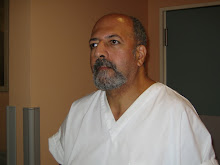
Edwyn Collins live. The Venue, Edinburgh
James Smart. Monday September 6, 2004. The Guardian
"I'm going back to my roots," announces Edwyn Collins. Tonight's one-off from the Scottish pop iconoclast is certainly simple. First he sits and sings and plays guitar; later he stands up to do the same, consulting his notepad for the set list. As a sort of final set piece, he is joined by a long-haired man named Andy, who mumbles a country song and plays lead guitar.
Collins is on beaming form: he stops songs to deliver anecdotes, offer a member of the audience 50p to safeguard his plectrum, knock the Libertines, tap-dance and sip other people's drinks. "It tastes Russian," he muses. "Must be Russian water."
It's an intimate and supremely likable showcase, as if your favourite rock god had decided to play a set from his bar stool. Collins, of course, never quite made it as a megastar, although he raided the top 10 both as a part of funky new wave outfit Orange Juice (with Rip It Up) and as a solo artist (with the briefly ubiquitous A Girl Like You).
He plays songs from both careers tonight. A touching Low Expectations, a sparky Gorgeous George and a sweetly resigned Consolation Prize illustrate a career that has been scattered with brilliance, his guitar slow-dancing beneath a voice that veers between gentle croon and deadpan mutter.
Incredibly, given the simplicity of the set-up, there are technical problems all night. Collins's guitar occasionally drops from the mix, and Andy's eventually packs up entirely. Such trouble seems emblematic of Collins's stop/start career and, fittingly, he carries on regardless. "I can't think which songs to do now we've only got one guitar," he announces affably. "So it's all fucked."
In such circumstances, A Girl Like You sounds less like carefully honed pop and more like a sensitive epic, full of ruffled beauty. When he encores with Orange Juice classic What Presence?!, the answer, plainly, is more than most acts could dream of.
lundi, septembre 06, 2004

dimanche, septembre 05, 2004
Reading Festival, Richmond Avenue, Reading
And the name of the world's worst band is...
By Simon Price
05 September 2004
Despatch from the Berkshire front. Rain incessant. Flooding biblical. Trench foot rife. Morale low. Cavalry has already lost seven horses, artillery is stuck in quicksand. They tell me it will all be over by Christmas. If I never make it out of here alive, please inform your mother that she has a penis.
On a day straight out of the Great War, only the true entertainers survive, so it's probably not a great surprise that curtain-raisers Goldie Lookin' Chain are the "surprise" hit of the Reading Festival, and their heavily Gwent-accented catchphrases - "your mother's got a penis!" etc - are as all-pervasive this year as was "Timmah!" a couple of years back.
The Welsh prankster rappers are rivalled, in the multi-membered mayhem stakes, by south-Londoner nine-piece Do Me Bad Things, the most blatant, gold-plated Ones To Watch that I encounter all weekend. Kitted out in trilbies and matching white/black outfits, DMBT play thrilling, no-rules glam-blues and soul-metal, with a perceptible edge of danger to it, a kind of Running-With-Scissors Sisters. Indeed, if the Scizzy Sissies had grown up in south London and listened to Seventies rock instead of disco, this is how they might have turned out.
They're followed by another supremely watchable troupe of chaos-mongers. Pink Grease, careering into one another, shrieking in ludicrous falsettos, wearing batwing blouses borrowed from their mums and playing basslines borrowed from The Cramps, are the gayest looking straight men in rock. They make the real New York Dolls, appearing on the main stage, obsolete.
Polar opposites to Pink Grease, but just as conscious of the importance of eye candy, are British Sea Power, whose intellectual, moving, epic, enigmatic rock is augmented visually by stuffed herons and owls, and a cult audience who flock to the front in vintage army uniforms, waving large pieces of foliage. Marvellous.
Some bands seem immune to the climatic conditions. There's a fantastic moment, during The Hives' set, when the Jumbotron camera zooms in on one be-spatted foot, pure white, unsullied by the quagmire. Proof, if it were needed, that Howlin' Pelle Almqvist walks on water. Similarly endowed with bulletproof self-confidence is Har Mar Superstar. And it's justified. The tide of humanity heading over to the Radio One stage shows that, despite his absurdly low billing, HMS is the tent-filler of the festival for the second year running.
Another buzz band, TV On The Radio, look amazing. Five people, four black, three with afros, two with dreads, one with an impressive Santa beard, they play heavy-headed blues-rock which takes you on a journey (from Hendrix via My Bloody Valentine). I've seen enough to know that they're very good, on their own terms. I've also seen enough to know I never want to see them again.
It quickly becomes clear that, for the second year in succession, The Libertines will be performing without the ever-troubled Pete Doherty. After strumming through "What a Waster" and a couple of other fan faves, Carl Barat asks if we have any requests. Nobody is sufficiently impolite to say "Yeah, we want Pete."
With each passing year, Reading seems to be separating into two festivals which happen to share the same terrain and time. The majority crowd are here for the punk-metal, the cooler minority to seek out the eclectic, arty indie stuff. But, even as an unashamed member of the latter faction, it's difficult to avoid accidentally catching the dire likes of Flogging Molly on the Concrete Jungle stage, which a friend of mine wearily christens the Tattooed Imbecile stage and which, with poetic synaesthesia, smells pungently of human waste.
The tattooed imbeciles' gods are Green Day. In another life, I interviewed the punk trio, amused by what I took to be their ironic take on slackerdom (songs about sitting on the sofa, unable to do anything but masturbate, drink beer and watch TV). I was quietly appalled when they told me they weren't being ironic and "y'know, sometimes that's just the way you feel..." Tonight, helped by a trumpeter in a bunny costume, they play a covers-heavy set. "This is a song written by The Clash," says Billy Jo, before playing "I Fought The Law", written by Bobby Fuller.
I've often wondered what the worst band in the world would be like. After watching the Dropkick Murphys, I need wonder no more. More or less an American Pogues, the Murphys come from Boston, used to wear kilts, and are the embodiment of the tendency of Yanks to claim that they're "Irish" just because they've got a couple of freckles and their great granny once drank a half of Guinness. At one point, while the singer sings earnestly and passionately and his bandmate tootles on a tin whistle, the Jumbotron cuts away to soft-focus footage of a soaring seagull. I kid you not.
Most Improved Act are the already-mighty Franz Ferdinand, who have added a pleasing new showbiz element to their live show. Plus a couple of new songs, "This Boy" and "Young Diary", which show that their astonishing debut album did not scrape their talent-barrel dry. New material is something The Darkness desperately need. As much as I adore them, they're below par at Reading. They've more or less admitted that they're knackered, and bored to tears with playing the same album night after night. They premiere one new song, "Hazel Eyes", which has a Scottish folk feel. Another one, still untitled, is only half-written, and ad-libbed live.
Jack White needs a shave, but face fuzz aside, The White Stripes are faultless, compelling and intensely thrilling. They even throw in the rarely-played "Hello Operator" as a treat. Another shock selection comes from Morrissey, who brings grown men to tears by opening with "How Soon is Now?", which creates enough goodwill to carry him through a set which, though frequently superb, is perhaps overstuffed with dirges (not to mention a slightly senile rant about getting a speeding fine in nearby Caversham).
By Sunday afternoon, the soil underfoot has solidified just enough to be manipulated into handy, missile-sized clumps by anyone with a malicious bent. This is bad news for Finnish pretty-boy goth-rockers The Rasmus, who are pelted with chunks of mud and bottles of urine by smelly punk kids. A few stray objects are hurled The Streets' way too, but Mike Skinner's charisma is strong enough to pacify the haters. "One bottle of piss and one bag of chips," he says phlegmatically, surveying the debris around him. "That's not bad going."
The next serious bombardment is directed at 50 Cent. We've established, then, that Reading Festival-goers are not too keen on 1) feminine-looking men, 2) rap music and 3) dare I controversially surmise, black people. (Check out the Dislikes section of any alternative rock kid's internet profile, and tell me that the words "hip-hop", "ghetto", "R&B", "urban" and "wigga" are not code.) Although his crew, G-Unit, look petrified, 50 Cent himself stands there grinning broadly as the missiles rain down. He has, famously, experienced a lot worse. He has also, it transpires, read the small print on his contract. If acts at Reading play less than 15 minutes, they forfeit their fee. At 15 minutes and one second, 50 Cent is gone.
One wonders what the organisers make of it all. To date, they have creditably tried to keep the Reading bill interesting by throwing non-rock acts into the mix, but how long can this policy survive in the face of literal mud-slinging? One day, the tattooed imbeciles may get the festival they deserve. And it will be rubbish.
s.price@independent.co.uk
©2004 Independent Digital (UK) Ltd. All rights reserved
By Simon Price
05 September 2004
Despatch from the Berkshire front. Rain incessant. Flooding biblical. Trench foot rife. Morale low. Cavalry has already lost seven horses, artillery is stuck in quicksand. They tell me it will all be over by Christmas. If I never make it out of here alive, please inform your mother that she has a penis.
On a day straight out of the Great War, only the true entertainers survive, so it's probably not a great surprise that curtain-raisers Goldie Lookin' Chain are the "surprise" hit of the Reading Festival, and their heavily Gwent-accented catchphrases - "your mother's got a penis!" etc - are as all-pervasive this year as was "Timmah!" a couple of years back.
The Welsh prankster rappers are rivalled, in the multi-membered mayhem stakes, by south-Londoner nine-piece Do Me Bad Things, the most blatant, gold-plated Ones To Watch that I encounter all weekend. Kitted out in trilbies and matching white/black outfits, DMBT play thrilling, no-rules glam-blues and soul-metal, with a perceptible edge of danger to it, a kind of Running-With-Scissors Sisters. Indeed, if the Scizzy Sissies had grown up in south London and listened to Seventies rock instead of disco, this is how they might have turned out.
They're followed by another supremely watchable troupe of chaos-mongers. Pink Grease, careering into one another, shrieking in ludicrous falsettos, wearing batwing blouses borrowed from their mums and playing basslines borrowed from The Cramps, are the gayest looking straight men in rock. They make the real New York Dolls, appearing on the main stage, obsolete.
Polar opposites to Pink Grease, but just as conscious of the importance of eye candy, are British Sea Power, whose intellectual, moving, epic, enigmatic rock is augmented visually by stuffed herons and owls, and a cult audience who flock to the front in vintage army uniforms, waving large pieces of foliage. Marvellous.
Some bands seem immune to the climatic conditions. There's a fantastic moment, during The Hives' set, when the Jumbotron camera zooms in on one be-spatted foot, pure white, unsullied by the quagmire. Proof, if it were needed, that Howlin' Pelle Almqvist walks on water. Similarly endowed with bulletproof self-confidence is Har Mar Superstar. And it's justified. The tide of humanity heading over to the Radio One stage shows that, despite his absurdly low billing, HMS is the tent-filler of the festival for the second year running.
Another buzz band, TV On The Radio, look amazing. Five people, four black, three with afros, two with dreads, one with an impressive Santa beard, they play heavy-headed blues-rock which takes you on a journey (from Hendrix via My Bloody Valentine). I've seen enough to know that they're very good, on their own terms. I've also seen enough to know I never want to see them again.
It quickly becomes clear that, for the second year in succession, The Libertines will be performing without the ever-troubled Pete Doherty. After strumming through "What a Waster" and a couple of other fan faves, Carl Barat asks if we have any requests. Nobody is sufficiently impolite to say "Yeah, we want Pete."
With each passing year, Reading seems to be separating into two festivals which happen to share the same terrain and time. The majority crowd are here for the punk-metal, the cooler minority to seek out the eclectic, arty indie stuff. But, even as an unashamed member of the latter faction, it's difficult to avoid accidentally catching the dire likes of Flogging Molly on the Concrete Jungle stage, which a friend of mine wearily christens the Tattooed Imbecile stage and which, with poetic synaesthesia, smells pungently of human waste.
The tattooed imbeciles' gods are Green Day. In another life, I interviewed the punk trio, amused by what I took to be their ironic take on slackerdom (songs about sitting on the sofa, unable to do anything but masturbate, drink beer and watch TV). I was quietly appalled when they told me they weren't being ironic and "y'know, sometimes that's just the way you feel..." Tonight, helped by a trumpeter in a bunny costume, they play a covers-heavy set. "This is a song written by The Clash," says Billy Jo, before playing "I Fought The Law", written by Bobby Fuller.
I've often wondered what the worst band in the world would be like. After watching the Dropkick Murphys, I need wonder no more. More or less an American Pogues, the Murphys come from Boston, used to wear kilts, and are the embodiment of the tendency of Yanks to claim that they're "Irish" just because they've got a couple of freckles and their great granny once drank a half of Guinness. At one point, while the singer sings earnestly and passionately and his bandmate tootles on a tin whistle, the Jumbotron cuts away to soft-focus footage of a soaring seagull. I kid you not.
Most Improved Act are the already-mighty Franz Ferdinand, who have added a pleasing new showbiz element to their live show. Plus a couple of new songs, "This Boy" and "Young Diary", which show that their astonishing debut album did not scrape their talent-barrel dry. New material is something The Darkness desperately need. As much as I adore them, they're below par at Reading. They've more or less admitted that they're knackered, and bored to tears with playing the same album night after night. They premiere one new song, "Hazel Eyes", which has a Scottish folk feel. Another one, still untitled, is only half-written, and ad-libbed live.
Jack White needs a shave, but face fuzz aside, The White Stripes are faultless, compelling and intensely thrilling. They even throw in the rarely-played "Hello Operator" as a treat. Another shock selection comes from Morrissey, who brings grown men to tears by opening with "How Soon is Now?", which creates enough goodwill to carry him through a set which, though frequently superb, is perhaps overstuffed with dirges (not to mention a slightly senile rant about getting a speeding fine in nearby Caversham).
By Sunday afternoon, the soil underfoot has solidified just enough to be manipulated into handy, missile-sized clumps by anyone with a malicious bent. This is bad news for Finnish pretty-boy goth-rockers The Rasmus, who are pelted with chunks of mud and bottles of urine by smelly punk kids. A few stray objects are hurled The Streets' way too, but Mike Skinner's charisma is strong enough to pacify the haters. "One bottle of piss and one bag of chips," he says phlegmatically, surveying the debris around him. "That's not bad going."
The next serious bombardment is directed at 50 Cent. We've established, then, that Reading Festival-goers are not too keen on 1) feminine-looking men, 2) rap music and 3) dare I controversially surmise, black people. (Check out the Dislikes section of any alternative rock kid's internet profile, and tell me that the words "hip-hop", "ghetto", "R&B", "urban" and "wigga" are not code.) Although his crew, G-Unit, look petrified, 50 Cent himself stands there grinning broadly as the missiles rain down. He has, famously, experienced a lot worse. He has also, it transpires, read the small print on his contract. If acts at Reading play less than 15 minutes, they forfeit their fee. At 15 minutes and one second, 50 Cent is gone.
One wonders what the organisers make of it all. To date, they have creditably tried to keep the Reading bill interesting by throwing non-rock acts into the mix, but how long can this policy survive in the face of literal mud-slinging? One day, the tattooed imbeciles may get the festival they deserve. And it will be rubbish.
s.price@independent.co.uk
©2004 Independent Digital (UK) Ltd. All rights reserved
Days of future past
Squeak. Wibble. Bzzz. My God, it's alienating in here! How do we know that? Because that noise we can hear is electronic soundtrack music, which can only mean one thing: the end of history, the future gone wrong, dystopia. And now the Pet Shop Boys are doing it too. Undaunted, Michael Bracewell traces the short, hissy relationship between film and electronica and wonders why we're all so tense?
05 September 2004
The hinterland is desolate - a dead suburbia. Grids of empty roads patched with dust and scrub stretch away to a blood-red horizon. The old police station stands open to the gathering night. There is tension in the air, which is at once urgent and melancholy. Against the play of such torpid, almost lifeless images run tense little jabs of electronic rhythm. This is the landscape of John Carpenter's film Assault on Precinct 13, which came out in 1976 with an electronics-based soundtrack composed by the director himself.
As a score, these minimalist bleeps and squeaks do the work of a full orchestra, and more. Electronic music has become the signal soundtrack to films which deal with societies in chaos and dystopic futures - the robotic requiem for post-industrial crisis. Their mood is one of suspenseful elegy. This is a genre steeped in romanticism: the sense, as noted by Neil Tennant of Pet Shop Boys' forthcoming score to Eisenstein's Battleship Potemkin, "of the struggle for a good revolution".
The timing of Assault on Precinct 13 - it came out as the Sex Pistols were releasing Anarchy In The UK - seemed to pick up on some deeper violence in the zeitgeist. It wasn't simply that Carpenter had made his movie and its soundtrack on a low-budget, low-fidelity basis echoing punk's no-budget aesthetic - Assault on Precinct 13 described the urban landscape with imagery which merged derelict modernity with the strangeness of science fiction, much as the first wave of punk's cultural rhetoric did. The fusion of these two qualities suggested a world in which time had reached critical mass, history had ended, and humanity was entering a "post-future" period.
In the beginning, in the 1950s, electronic soundtracks were seen as novelty rather than artistic advance. In American television series such as The Outer Limits, for example, the hums and splutters of sinister robots were deployed less as a form of incidental "music", than as sound effects. There was a more sophisticated and enquiring experiment with electronic soundtrack in Forbidden Planet (1956) which transposed the plot of Shakespeare's The Tempest to the planet Altair Four in the year 2200. In this, the distinction between soundtrack and sound effect became more ambiguous, as electronic tremors and pulses were used to denote the workings of Prospero's magic.
After Forbidden Planet, electronics went into cinematic abeyance until the early Seventies. While electronic music itself was being pioneered by both classical and rock musicians - notably in Germany, where the avant-garde in rock music gave rise to the likes of Can, Kraftwerk, Neu, Amon Duul and Tangerine Dream - its relation to the moving image existed only on the extreme fringes of experimental cinema, and then sparsely. The pioneering work of the BBC Radiophonic Workshop - a notable presence in television drama in the Sixties - did not extend to feature-film soundtracks.
It would take until the middle of the punk decade for the technology of electronic music to become sufficiently sophisticated - and fashionable - to find a place in the cinema. And even this emergence would be of limited scope, until the electronic soundtrack boom at the end of the Seventies. There were, of course, a few notable exceptions. Nicolas Roeg and Donald Cammell's lysergic portrait of the identity breakdown of a London gangster, Performance (1970), opened with a disturbing montage that cut abruptly between images of a Rolls-Royce passing through the English countryside and dizzying glimpses of explicit sex. The soundtrack featured subterranean drones and curved arcs of electronic sound, reminiscent of the sound of pumping blood on an ultrasound scan.
The tenor of the times required nothing less. As the counter-cultural idealism of the second half of the Sixties curdled and soured, so British cinema in the early Seventies immersed itself in brutalism. The new decade was inscribed in concrete monoliths, from the subways of A Clockwork Orange to the Newcastle-under-reconstruction of Get Carter. As A Clockwork Orange portrayed the youth cults of a dystopic future, so its soundtrack featured Beethoven's Ninth played on a synthesiser. The sum effect was the representation of a plasticised culture in decay, outlining a vision of Britain Derek Jarman portrayed nearly a decade later in Jubilee.
It was during the immediate aftermath of punk's first impact, between 1977 and 1979, that the relationship between film and "electronica" seemed really to stick. The experimental Sheffield groups Cabaret Voltaire and The Human League were themselves steeped in visual culture. Their early recordings - using primitive synthesisers, electronic keyboards and reel-to-reel tape effects - were instantly recognisable as filmic soundtracks to the landscape of contemporary industrial alienation. Phil Oakey, co-founder of The Human League, later described such times as the "alienated synthesiser period". And once they'd established themselves as a vital new element in post-punk electronica, Cabaret Voltaire recorded a haunting interpretation of Henry Mancini's opening music to A Touch Of Evil(on perhaps their best album, Red Mecca in 1979), while The Human League included a version of Roy Budd's theme to Get Carter on their multi-million selling album, Dare!
In many ways, it was the romanticism of living in an "end-of-history" epoch which so appealed to the more experimental young groups and established the strong link between cinema and electronica. This goes at least half way to explaining where the Pet Shop Boys came from (the other half being, according to Tennant and Lowe, the hi-energy disco sound of Bobby O) - the unique fusion of cinematic melancholy and pure pop rush.
But while post-punk electronica was heavily influenced by film and was filmic in its own right, there was counterpoint in cinema's response to the evolving world of electronica. This evolution connected the avant-garde end of post-punk, the possibilities of dance music and the lingering influence of the "symphonic" synthesiser works by the German pioneers of progressive rock.
The central figure in British experiments with electronic soundtrack music is Brian Eno, whose work as both a composer and a conceptual thinker has been pivotal in the development of "filmic" ambient music. Eno's application of generative systems to artistic media, going back to his earliest days as a student at Colchester and then Winchester Schools of Art, became the conceptual machinery behind a whole new form of musical minimalism.
One example is his soundtrack to Jarman's Jubilee (1978). Plangent, eerie and melancholy, Eno's music caught exactly the strangeness and ambiguity of Jarman's vision of a nightmarish England. The music - as with Eno's later soundtrack for Jarman's montage of home-movie fragments, Glitterbug - conveys a sense of film's relationship with time. The pulses, chords and tones create a solid chassis for the narrating images yet retain their atomised sense of ambience. They sound like recordings from the future, yet possess a sense of being broadcast from the past.
It has been argued - by the writer Mark Sinker in an essay published in Jonathan Romney's survey volume, Celluloid Jukebox - that Brian Eno's collaborations with David Bowie on Low and Heroes (both recorded in Germany) mark a turning point in the relationship between electronic music and film. "The hook," wrote Sinker of Low, which was released shortly after Bowie appeared as an alien in Roeg's The Man Who Fell to Earth, "is the lack. The sleeve shot is a still from The Man Who Fell To Earth: as if this were a record made by a fictional character, an alien in a movie. Eno's ambient backdrops become the foreground; the important content is the decor. By draining colour from the main man, the Bowie/Eno partnership invented background music without a foreground."
Memorably described by the critic Jon Savage as "post-everything music", Bowie and Eno's collaborations on Low established a model for filmic electronica and electronic film soundtracks. For instance, the portentous electronic score composed and recorded by Francis Ford Coppola and his father Carmine, for Apocalypse Now in 1979, sounded in places like a homage to the Bowie/Eno model.
In 1982, yet another cult film describing a dystopic future world, Blade Runner, featured an electronic soundtrack, this time by the Greek keyboard wiz Vangelis. As a specific cinema score, the music eased post-punk electronica away from cerebral aestheticism towards the melodrama, urgency and sheer orchestral scale required of film music proper - echoes of which can be heard in sections of Brad Fiedel's soundtrack to Terminator 2: Judgement Day.
But electronica isn't always about pushing into the future - it works retrospectively too. Two silent films which addressed the future and the newly mechanised, depersonalised city - Fritz Lang's Metropolis (1926) and Dziga Vertov's The Man With The Movie Camera (1928) - have both inspired contemporary electronic scores. In fact, Metropolis can be seen as a defining film in the relationship between electronics and cinema. A Gothic Futurist fable, endowed with monolithic factories, a mystical philosopher-scientist and an erotic female robot, the imagery of Metropolis pretty much tallies with the preoccupations of post-punk and New Romantic synthesiser music. Indeed, the pioneering electronic music quartet from Dusseldorf, Kraftwerk, recorded a track inspired by the film on their breakthrough 1978 album, The Man Machine. Kraftwerk's entire visual aesthetic is based on a paradoxical nostalgia for archaic visions of the future, with specific reference to German cultural history. Metropolis, then, was a perfect source of inspiration. It is also a film which articulates Walter Benjamin's aesthetic philosophy of the modern urban wanderer, caught between alienation and a romantic obsession with the city.
In 1984 - just two years before the hip-hop pioneer Afrika Bambaataa sampled the score to Assault on Precinct 13 for "Bambaataa's Theme" - a new, freshly tinted edition of Metropolis was released with an electronic soundtrack by Giorgio Moroder (who, incidentally, had already won an Oscar for his electronic score to Midnight Express). More recently, the Sheffield-based electronic duo From The Nursery have toured with a print of Vertov's The Man With A Movie Camera, playing a live electronic soundtrack to the Russian silent masterpiece, which blends the quotidian pathos of city life with touches of surrealist imagery.
Looking back from the lobby of the 21st century, one can see how a "golden age" of electronics-based film music seemed to declare itself between 1976 and 1984, when the classics of the genre emerged. Today, scores such as Assault on Precinct 13 or Eno's work for Derek Jarman have taken their place as great pieces of music in their own right - the Nino Rota and Bernard Hermann of the punk generation.
And there is a neat aesthetic irony in the broader project of today's electronica seeming to be as interested in the possibilities of "classical" music, as it is in honing soundscapes of bleeps and squeaks. Thus the classic atmosphere generated by electronic music - that eerie, plangent tension - is finding a refreshed intensity. The acclaimed Systems/Layers album, by the US ensemble Rachel's, for instance, sounds more like Gorecki or Hindemith than Plastikman.
The forthcoming Pet Shop Boys Battleship Potemkin project is being performed in collaboration with the Dresden Sinfoniker and is rumoured to include at least glancing musical references to such 20th-century modernists as Schoenberg and Alban Berg. Such a heady fusion of styles - European modernism and electronic beats - is of course completely of a piece with the formalism which the Pet Shop Boys have refined to perfection throughout their career. Indeed, one of the reasons why the group remain so enduringly and intensely "modern" is the sheer dexterity of their musical balancing act between poised intellectualism and the rush of dance music. And as film soundtrack music goes, the potential is breathtaking: Giorgio Moroder meets Georges Auric.
The legacy of cinema's post-punk love affair with electronics is still producing potent and adventurous soundtrack music; a genre which you might describe as musical landscape poetry - composed by humans, sequenced by robots.
The Pet Shop Boys will accompany a free screening of 'Battleship Potemkin' in Trafalgar Square, London as part of the Summer in the Square festival; 8.30pm, 12 September. www.london.gov.uk.
Brian Eno's 'Ambient Works' are reissued on 27 September by Virgin Records
CELLULOID ELECTRONICA
Metropolis (1926)
In this re-tinted, re-scored re-release by Giorgio Moroder from 1984, the robotic sheen of Kraftwerk's track "Metropolis" - with its one-word lyric - is very much in keeping with Fritz Lang's vision of a dehumanised future.
Jubilee (1978)
Described as a "non-punk film using punk people", Jarman's film featured music by Siouxsie and The Banshees and Adam And The Ants, as well as a newly composed electronic soundtrack - eerie and plangent - by Brian Eno.
Assault on Precinct 13 (1976)
Perhaps the most revered electronic soundtrack, scored by John Carpenter. The soundtrack album became the holy grail of electronica fans, not least because until recently it was very difficult to get hold of.
Get Carter (1970)
Of interest to electronica fans because of The Human League's 1982 cover version (just over a minute long) of Roy Budd's original theme.
A Clockwork Orange (1970)
When Bowie sang "hey droogie, don't crash here" on 'Ziggy Stardust', he acknowledged Stanley Kubrick's horrific vision of a dystopic society as a founding statement of Seventies pop culture. The synthesised Beethoven has not aged as well as Bowie's name-check.
©2004 Independent Digital (UK) Ltd. All rights reserved
05 September 2004
The hinterland is desolate - a dead suburbia. Grids of empty roads patched with dust and scrub stretch away to a blood-red horizon. The old police station stands open to the gathering night. There is tension in the air, which is at once urgent and melancholy. Against the play of such torpid, almost lifeless images run tense little jabs of electronic rhythm. This is the landscape of John Carpenter's film Assault on Precinct 13, which came out in 1976 with an electronics-based soundtrack composed by the director himself.
As a score, these minimalist bleeps and squeaks do the work of a full orchestra, and more. Electronic music has become the signal soundtrack to films which deal with societies in chaos and dystopic futures - the robotic requiem for post-industrial crisis. Their mood is one of suspenseful elegy. This is a genre steeped in romanticism: the sense, as noted by Neil Tennant of Pet Shop Boys' forthcoming score to Eisenstein's Battleship Potemkin, "of the struggle for a good revolution".
The timing of Assault on Precinct 13 - it came out as the Sex Pistols were releasing Anarchy In The UK - seemed to pick up on some deeper violence in the zeitgeist. It wasn't simply that Carpenter had made his movie and its soundtrack on a low-budget, low-fidelity basis echoing punk's no-budget aesthetic - Assault on Precinct 13 described the urban landscape with imagery which merged derelict modernity with the strangeness of science fiction, much as the first wave of punk's cultural rhetoric did. The fusion of these two qualities suggested a world in which time had reached critical mass, history had ended, and humanity was entering a "post-future" period.
In the beginning, in the 1950s, electronic soundtracks were seen as novelty rather than artistic advance. In American television series such as The Outer Limits, for example, the hums and splutters of sinister robots were deployed less as a form of incidental "music", than as sound effects. There was a more sophisticated and enquiring experiment with electronic soundtrack in Forbidden Planet (1956) which transposed the plot of Shakespeare's The Tempest to the planet Altair Four in the year 2200. In this, the distinction between soundtrack and sound effect became more ambiguous, as electronic tremors and pulses were used to denote the workings of Prospero's magic.
After Forbidden Planet, electronics went into cinematic abeyance until the early Seventies. While electronic music itself was being pioneered by both classical and rock musicians - notably in Germany, where the avant-garde in rock music gave rise to the likes of Can, Kraftwerk, Neu, Amon Duul and Tangerine Dream - its relation to the moving image existed only on the extreme fringes of experimental cinema, and then sparsely. The pioneering work of the BBC Radiophonic Workshop - a notable presence in television drama in the Sixties - did not extend to feature-film soundtracks.
It would take until the middle of the punk decade for the technology of electronic music to become sufficiently sophisticated - and fashionable - to find a place in the cinema. And even this emergence would be of limited scope, until the electronic soundtrack boom at the end of the Seventies. There were, of course, a few notable exceptions. Nicolas Roeg and Donald Cammell's lysergic portrait of the identity breakdown of a London gangster, Performance (1970), opened with a disturbing montage that cut abruptly between images of a Rolls-Royce passing through the English countryside and dizzying glimpses of explicit sex. The soundtrack featured subterranean drones and curved arcs of electronic sound, reminiscent of the sound of pumping blood on an ultrasound scan.
The tenor of the times required nothing less. As the counter-cultural idealism of the second half of the Sixties curdled and soured, so British cinema in the early Seventies immersed itself in brutalism. The new decade was inscribed in concrete monoliths, from the subways of A Clockwork Orange to the Newcastle-under-reconstruction of Get Carter. As A Clockwork Orange portrayed the youth cults of a dystopic future, so its soundtrack featured Beethoven's Ninth played on a synthesiser. The sum effect was the representation of a plasticised culture in decay, outlining a vision of Britain Derek Jarman portrayed nearly a decade later in Jubilee.
It was during the immediate aftermath of punk's first impact, between 1977 and 1979, that the relationship between film and "electronica" seemed really to stick. The experimental Sheffield groups Cabaret Voltaire and The Human League were themselves steeped in visual culture. Their early recordings - using primitive synthesisers, electronic keyboards and reel-to-reel tape effects - were instantly recognisable as filmic soundtracks to the landscape of contemporary industrial alienation. Phil Oakey, co-founder of The Human League, later described such times as the "alienated synthesiser period". And once they'd established themselves as a vital new element in post-punk electronica, Cabaret Voltaire recorded a haunting interpretation of Henry Mancini's opening music to A Touch Of Evil(on perhaps their best album, Red Mecca in 1979), while The Human League included a version of Roy Budd's theme to Get Carter on their multi-million selling album, Dare!
In many ways, it was the romanticism of living in an "end-of-history" epoch which so appealed to the more experimental young groups and established the strong link between cinema and electronica. This goes at least half way to explaining where the Pet Shop Boys came from (the other half being, according to Tennant and Lowe, the hi-energy disco sound of Bobby O) - the unique fusion of cinematic melancholy and pure pop rush.
But while post-punk electronica was heavily influenced by film and was filmic in its own right, there was counterpoint in cinema's response to the evolving world of electronica. This evolution connected the avant-garde end of post-punk, the possibilities of dance music and the lingering influence of the "symphonic" synthesiser works by the German pioneers of progressive rock.
The central figure in British experiments with electronic soundtrack music is Brian Eno, whose work as both a composer and a conceptual thinker has been pivotal in the development of "filmic" ambient music. Eno's application of generative systems to artistic media, going back to his earliest days as a student at Colchester and then Winchester Schools of Art, became the conceptual machinery behind a whole new form of musical minimalism.
One example is his soundtrack to Jarman's Jubilee (1978). Plangent, eerie and melancholy, Eno's music caught exactly the strangeness and ambiguity of Jarman's vision of a nightmarish England. The music - as with Eno's later soundtrack for Jarman's montage of home-movie fragments, Glitterbug - conveys a sense of film's relationship with time. The pulses, chords and tones create a solid chassis for the narrating images yet retain their atomised sense of ambience. They sound like recordings from the future, yet possess a sense of being broadcast from the past.
It has been argued - by the writer Mark Sinker in an essay published in Jonathan Romney's survey volume, Celluloid Jukebox - that Brian Eno's collaborations with David Bowie on Low and Heroes (both recorded in Germany) mark a turning point in the relationship between electronic music and film. "The hook," wrote Sinker of Low, which was released shortly after Bowie appeared as an alien in Roeg's The Man Who Fell to Earth, "is the lack. The sleeve shot is a still from The Man Who Fell To Earth: as if this were a record made by a fictional character, an alien in a movie. Eno's ambient backdrops become the foreground; the important content is the decor. By draining colour from the main man, the Bowie/Eno partnership invented background music without a foreground."
Memorably described by the critic Jon Savage as "post-everything music", Bowie and Eno's collaborations on Low established a model for filmic electronica and electronic film soundtracks. For instance, the portentous electronic score composed and recorded by Francis Ford Coppola and his father Carmine, for Apocalypse Now in 1979, sounded in places like a homage to the Bowie/Eno model.
In 1982, yet another cult film describing a dystopic future world, Blade Runner, featured an electronic soundtrack, this time by the Greek keyboard wiz Vangelis. As a specific cinema score, the music eased post-punk electronica away from cerebral aestheticism towards the melodrama, urgency and sheer orchestral scale required of film music proper - echoes of which can be heard in sections of Brad Fiedel's soundtrack to Terminator 2: Judgement Day.
But electronica isn't always about pushing into the future - it works retrospectively too. Two silent films which addressed the future and the newly mechanised, depersonalised city - Fritz Lang's Metropolis (1926) and Dziga Vertov's The Man With The Movie Camera (1928) - have both inspired contemporary electronic scores. In fact, Metropolis can be seen as a defining film in the relationship between electronics and cinema. A Gothic Futurist fable, endowed with monolithic factories, a mystical philosopher-scientist and an erotic female robot, the imagery of Metropolis pretty much tallies with the preoccupations of post-punk and New Romantic synthesiser music. Indeed, the pioneering electronic music quartet from Dusseldorf, Kraftwerk, recorded a track inspired by the film on their breakthrough 1978 album, The Man Machine. Kraftwerk's entire visual aesthetic is based on a paradoxical nostalgia for archaic visions of the future, with specific reference to German cultural history. Metropolis, then, was a perfect source of inspiration. It is also a film which articulates Walter Benjamin's aesthetic philosophy of the modern urban wanderer, caught between alienation and a romantic obsession with the city.
In 1984 - just two years before the hip-hop pioneer Afrika Bambaataa sampled the score to Assault on Precinct 13 for "Bambaataa's Theme" - a new, freshly tinted edition of Metropolis was released with an electronic soundtrack by Giorgio Moroder (who, incidentally, had already won an Oscar for his electronic score to Midnight Express). More recently, the Sheffield-based electronic duo From The Nursery have toured with a print of Vertov's The Man With A Movie Camera, playing a live electronic soundtrack to the Russian silent masterpiece, which blends the quotidian pathos of city life with touches of surrealist imagery.
Looking back from the lobby of the 21st century, one can see how a "golden age" of electronics-based film music seemed to declare itself between 1976 and 1984, when the classics of the genre emerged. Today, scores such as Assault on Precinct 13 or Eno's work for Derek Jarman have taken their place as great pieces of music in their own right - the Nino Rota and Bernard Hermann of the punk generation.
And there is a neat aesthetic irony in the broader project of today's electronica seeming to be as interested in the possibilities of "classical" music, as it is in honing soundscapes of bleeps and squeaks. Thus the classic atmosphere generated by electronic music - that eerie, plangent tension - is finding a refreshed intensity. The acclaimed Systems/Layers album, by the US ensemble Rachel's, for instance, sounds more like Gorecki or Hindemith than Plastikman.
The forthcoming Pet Shop Boys Battleship Potemkin project is being performed in collaboration with the Dresden Sinfoniker and is rumoured to include at least glancing musical references to such 20th-century modernists as Schoenberg and Alban Berg. Such a heady fusion of styles - European modernism and electronic beats - is of course completely of a piece with the formalism which the Pet Shop Boys have refined to perfection throughout their career. Indeed, one of the reasons why the group remain so enduringly and intensely "modern" is the sheer dexterity of their musical balancing act between poised intellectualism and the rush of dance music. And as film soundtrack music goes, the potential is breathtaking: Giorgio Moroder meets Georges Auric.
The legacy of cinema's post-punk love affair with electronics is still producing potent and adventurous soundtrack music; a genre which you might describe as musical landscape poetry - composed by humans, sequenced by robots.
The Pet Shop Boys will accompany a free screening of 'Battleship Potemkin' in Trafalgar Square, London as part of the Summer in the Square festival; 8.30pm, 12 September. www.london.gov.uk.
Brian Eno's 'Ambient Works' are reissued on 27 September by Virgin Records
CELLULOID ELECTRONICA
Metropolis (1926)
In this re-tinted, re-scored re-release by Giorgio Moroder from 1984, the robotic sheen of Kraftwerk's track "Metropolis" - with its one-word lyric - is very much in keeping with Fritz Lang's vision of a dehumanised future.
Jubilee (1978)
Described as a "non-punk film using punk people", Jarman's film featured music by Siouxsie and The Banshees and Adam And The Ants, as well as a newly composed electronic soundtrack - eerie and plangent - by Brian Eno.
Assault on Precinct 13 (1976)
Perhaps the most revered electronic soundtrack, scored by John Carpenter. The soundtrack album became the holy grail of electronica fans, not least because until recently it was very difficult to get hold of.
Get Carter (1970)
Of interest to electronica fans because of The Human League's 1982 cover version (just over a minute long) of Roy Budd's original theme.
A Clockwork Orange (1970)
When Bowie sang "hey droogie, don't crash here" on 'Ziggy Stardust', he acknowledged Stanley Kubrick's horrific vision of a dystopic society as a founding statement of Seventies pop culture. The synthesised Beethoven has not aged as well as Bowie's name-check.
©2004 Independent Digital (UK) Ltd. All rights reserved
Julian Cope
Eighties idol hits big time as prehistoric rock star
By Anthony Barnes, Arts and Media Correspondent
05 September 2004
To many he is the indie star who first found fame as the frontman for The Teardrop Explodes and, apart from a bizarre appearance on Top of the Pops dressed in a thong, faded into cult obscurity.
But to his publisher, Julian Cope is an extraordinary - albeit unlikely - book phenomenon, having reinvented himself as a sage of the prehistoric era.
The musician is now regarded as an authority on the pagan world with a best-selling tome behind him, The Modern Antiquarian, about the stone circles of Britain, which went on to be adapted into a BBC2 documentary. Despite being the size of an atlas and with a cover price of £30, it sold 30,000 copies - a colossal figure for such a specialist publication.
Now Cope, 46, is aiming to repeat the success with a definitive guide to the prehistoric sites of Europe to be published next month. It is the result of five years' work and involved visits to 550 locations, which he whittled down to 320 for inclusion in The Megalithic European. Such is the expectation that his publisher, an offshoot of HarperCollins, has already commissioned his next book.
The books are a hybrid of historical scholarship, travelogue and guide book to some of the world's oldest man-made structures. The singer of "Reward" and "Treason" and former chart star who once graced the covers of teen pop magazines has even hosted well-attended lecture tours to expand on his views about the ancient world.
Even he is bemused by the success: "It is a weird one. Neither I nor the publishers expected anything like it. I think they were being very forward-thinking just publishing it, and I think it has put them in a very strong position. When they commissioned this new one it was a chance to consolidate what we did in the first one."
Cope - whose solo hits include the anthemic "World Shut Your Mouth" - had initially explored his fascination with our pagan past through his music, but after a warm reception for his autobiography Head On - followed by a later volume, Repossessed - his publisher agreed to take on his exploration of a different kind of rock.
Although he continues to make music, releasing a vast amount of music through his Headheritage website under a variety of aliases such as Brain Donor and Queen Elizabeth, much of his time has been taken up with his research and writing.
"I'm in an enviable position to be able to do it. I see so many of my contemporaries in the invidious position of having to get their groups back together to make some money, but I don't have to do that. I'm self-sufficient. I think the problem is that people forget you exist in the ephemeral rock'n'roll business - people think Cope doesn't do anything any more."
Cope said the experience of researching the book, published on 19 October, did not match up to that of the first: "I can't say I enjoyed it as much. In Britain I know what people are saying when they are being rude about me being a 'long-hair'. But in Europe I'm not quite sure what they are saying when they are being rude in other languages. Are you being rude as in 'get off my land' or as in 'I'm calling the police'?"
©2004 Independent Digital (UK) Ltd. All rights reserved
By Anthony Barnes, Arts and Media Correspondent
05 September 2004
To many he is the indie star who first found fame as the frontman for The Teardrop Explodes and, apart from a bizarre appearance on Top of the Pops dressed in a thong, faded into cult obscurity.
But to his publisher, Julian Cope is an extraordinary - albeit unlikely - book phenomenon, having reinvented himself as a sage of the prehistoric era.
The musician is now regarded as an authority on the pagan world with a best-selling tome behind him, The Modern Antiquarian, about the stone circles of Britain, which went on to be adapted into a BBC2 documentary. Despite being the size of an atlas and with a cover price of £30, it sold 30,000 copies - a colossal figure for such a specialist publication.
Now Cope, 46, is aiming to repeat the success with a definitive guide to the prehistoric sites of Europe to be published next month. It is the result of five years' work and involved visits to 550 locations, which he whittled down to 320 for inclusion in The Megalithic European. Such is the expectation that his publisher, an offshoot of HarperCollins, has already commissioned his next book.
The books are a hybrid of historical scholarship, travelogue and guide book to some of the world's oldest man-made structures. The singer of "Reward" and "Treason" and former chart star who once graced the covers of teen pop magazines has even hosted well-attended lecture tours to expand on his views about the ancient world.
Even he is bemused by the success: "It is a weird one. Neither I nor the publishers expected anything like it. I think they were being very forward-thinking just publishing it, and I think it has put them in a very strong position. When they commissioned this new one it was a chance to consolidate what we did in the first one."
Cope - whose solo hits include the anthemic "World Shut Your Mouth" - had initially explored his fascination with our pagan past through his music, but after a warm reception for his autobiography Head On - followed by a later volume, Repossessed - his publisher agreed to take on his exploration of a different kind of rock.
Although he continues to make music, releasing a vast amount of music through his Headheritage website under a variety of aliases such as Brain Donor and Queen Elizabeth, much of his time has been taken up with his research and writing.
"I'm in an enviable position to be able to do it. I see so many of my contemporaries in the invidious position of having to get their groups back together to make some money, but I don't have to do that. I'm self-sufficient. I think the problem is that people forget you exist in the ephemeral rock'n'roll business - people think Cope doesn't do anything any more."
Cope said the experience of researching the book, published on 19 October, did not match up to that of the first: "I can't say I enjoyed it as much. In Britain I know what people are saying when they are being rude about me being a 'long-hair'. But in Europe I'm not quite sure what they are saying when they are being rude in other languages. Are you being rude as in 'get off my land' or as in 'I'm calling the police'?"
©2004 Independent Digital (UK) Ltd. All rights reserved
samedi, septembre 04, 2004
Nick Cave: Wild Rose
From post-punk icon to Kylie corrupter, Nick Cave has been many things. But contented family man? Fiona Sturges pays him a visit
04 September 2004
Nick Cave is pondering, in his tentative, slightly abstract way, on the lure of live performance. "On stage I think you have permission to be the person that you were designed to be, but for whatever reasons, you haven't quite become." He pauses, shifts in his seat and looks out of the window. "There's this feeling I get when I'm up there of being super-capable and super-confident," he continues, "that I can't do anything wrong. I just never got that feeling anywhere else, except perhaps with drugs."
Under different circumstances, I suspect the Australian musician might be good company (he certainly does a good line in self-deprecating humour). But being interviewed clearly isn't among his favourite occupations and as he sits, smoking furiously and struggling to encase his elongated limbs in a small leather armchair, he retains the anxious look of a schoolboy who has been hauled into the headmaster's office to receive his punishment.
Though he's never less than polite, he seems particularly ill at ease when the conversation strays on to matters of his personal life. You sense his reticence isn't just about protecting his privacy, although that is certainly a factor. Retrospection and re-evaluation just aren't in his nature. As he tells me with a note of helplessness: "What's happened in my life has happened, much of it wonderful, some of it not quite so wonderful. No matter how much you pick over it, you're still the same person."
I meet Cave, dapper as ever in a brown suit and scrupulously shiny shoes, in his office near his home in Hove, East Sussex, where he works nine to five. It's an airy room not far from the seafront, containing a computer, two pianos and a tiny kitchen. The walls are covered with bookshelves containing biographical tomes on Nabakov, Auden, Blake and Beckett, writers who have long been legible in his work, and at least two copies of the Bible. "I write here because I don't want to do it at home," he says. "I don't think my family should be subjected to the creative process which is undignified and shouldn't be seen by anyone. It's kind of like closing the door when you use the toilet."
At 47, Cave remains a vital force in music. As well as composing songs for other people, as he has recently done for Marianne Faithfull, he and his redoubtable backing band the Bad Seeds have just released a double album entitled Abattoir Blues/The Lyre of Orpheus. It is, Cave insists, "a masterpiece, and this is not something I say with every record I've done. It's well known that I've always been self-flagellating about my music but I really believe this is great. If other people don't it's just because they haven't listened to it enough."
It is certainly the best album he's made in a long while, perhaps even since 1997's elegiac The Boatman's Call. While the music moves between bluesy swamp-rock and piano-led balladry (replete with backing vocals from the London Gospel Community Choir), the lyrical narratives are quintessential Cave. "Cannibal's Hymn" sees him slyly defrocking a woman on a river's edge while "Hiding All Away" has its hapless heroine basted in butter and bundled into a bread oven.
Until now the creative process has been an isolated business, with Cave composing songs in his office and presenting them to the band. This time around, however, the Bad Seeds were involved from the start.
"I've had experiences in the past where I've taken something into the studio and as I've played it I've known it's really bad," Cave explains. "You finish it and there's this deathly silence. This time around we went into this studio in Paris for five days to see if we could write some songs as a group. It meant that we'd just sit there with our instruments and plough into something without any knowledge of what the song would be."
From his early days as the shock-headed singer with post-punk reprobates The Birthday Party through to his present incarnation as one of the leading songwriters of his generation, Cave has inspired fevered devotion among his fans. Arriving in Britain from their native Melbourne in the early Eighties, the band became notorious for their chaotic, often violent live shows, and Cave an emblem for disaffected youth, a depraved anti-hero whose articulation of wretchedness and obsession stood in stark contrast to the silly melodrama of New Romanticism. On stage this reticent young man was transformed into a demon preacher spouting darkly theatrical lyrics in a furious blood-curdling howl.
His off-stage antics were no less dramatic. With hurricane-like intensity he embarked on a relentless campaign of self-destruction. Legend has it that a stick-thin Cave was once seen on the London Underground writing a letter with a syringe loaded with blood. In the mid-Eighties he briefly moved to Berlin f where he subsisted on a diet of speed and heroin, leavened by hefty helpings of the Bible.
Musically, Cave didn't realise his full potential until joining forces with the Bad Seeds. From their earliest incarnation of Mick Harvey, Blixa Bargeld, Hugo Race and Barry Adamson, through to the seven-piece of recent years, the group has underpinned Cave's verses with dense atmospherics inspired by the fire-and-brimstone blues of Charlie Patton and Robert Johnson, the dark country of Johnny Cash and the lugubriousness of Leonard Cohen.
The Nineties brought a mellowing of Cave's spirit, a situation no doubt improved by the kicking of his heroin habit. He became a balladeer, albeit of a murderous variety. Cave is still probably best known for "Where The Wild Roses Grow" - the 1996 duet with Kylie Minogue where he imagined pummelling his muse's head with a rock - his one and only hit. (Though the inclusion of "People Ain't No Good" on the Shrek 2 soundtrack, has brought his music to another audience entirely). Success didn't agree with rock's most notorious curmudgeon, however. In requesting that his nomination for Best Male Artist at the MTV awards be withdrawn, he wrote: "My muse is not a horse and I am in no horse race and if indeed she was, still I would not harness her to this tumbrel, this bloody cart of severed heads and glittering prizes. My muse may spook! May bolt! May abandon me completely!"
Cave's current muse is the English model Susie Bick, whom he married on the day of the eclipse in 1999 and with whom he has twin sons, Earl and Arthur (Cave has two more sons, Luke and Jethro, from previous relationships). While he admits to being contented with his present life, he takes pains to explain that this is not at the expense of his past. "I do know a lot of people who've gone through a similar thing and denied what has gone before," he says. "It's like a born-again thing where you clean up and fall in love and everything that happened before is suddenly worthless. I don't see my life that way at all. You still haul yourself with you, no matter what you've been through. You still have the same difficulties with the world. The fact that your circumstances have changed doesn't necessarily remedy that. You just learn how to duck and weave and not be constantly up against it, and I suppose I've learnt that."
"I have a really great relationship with my wife," he says with sudden tenderness. "She's enormously supportive and there's a general feeling between us that we're both on the same side. Not going at it toe to toe with the person I'm with is quite a unique situation for me. I feel very lucky."
As a child growing up outside Melbourne, Cave always knew he wanted to perform. "When I danced around privately up in my bedroom to Bowie records, it made me feel like the person I wanted to be, and not the schmuck that I felt I actually was," he says blithely. After being forcibly ejected from art college in his late teens, he started his first rock band. Looking back, he realises his parents were very supportive despite his best efforts to undermine their expectations.
His father, who died when he was 19, was an English Literature teacher and helped nurture his son's love of books. Was starting up a band an act of rebellion? "It may have been but I don't think he saw it that way," Cave replies. "I remember showing him my first record which had a song on it called 'Masturbation Generation'. He just looked baffled, which was quite crushing but at the same time I understood his reaction. In some fucked-up way I probably encouraged it. He thought literature was at the very top of the learning pyramid and that Shakespeare was there balancing on the top. He may well have thought that all his efforts that he had put into me had been squandered. And then he died, so he never got to see where that kind of stuff went." Cave's mother, to whom he is close, is a much-valued critic of his work. Of his own role as a parent Cave says: "I do make some efforts to guide [my children's] interests but I also encourage them in whatever they want to do. My game plan as a father is non-existent. It's only when you become a parent that you suddenly realise that your own parents were winging it day by day as well and that's enormously reassuring."
It has taken nearly 25 years for him to become comfortable with his position, if not as an icon, then as a singer and songwriter of acclaim. "I suppose I can write musician on an immigration document as my profession without blushing with shame," he says grudgingly. "I've come to understand music better in the last 10 years, and my place in it. For a start I can play it better - I'm a better pianist and singer, and with that comes a certain confidence. For most of my twenties and thirties I just felt like an impostor."
Which might explain why Cave has always sought to broaden his horizons. In 1989 he published his acclaimed first and only novel, And The Ass Saw The Angel, an apocalyptic tale set in the imagined Deep South. While he hasn't ruled out a second, Cave says he's unlikely to find the time to write it. "If I have two years to spare I'll do it. If I wrote two I'd really be an author - having only written one I'm just some jerk who wrote a book. And the world's full of them already."
In recent years he's reinvented himself as an essayist, writing an introduction to the Gospel According to Mark for Canongate's mini-bible series, and delivering lectures on the love song at London's Royal Festival Hall and the Viennese Poetry Academy. This year he also completed a script for The Proposition, an Australian bushranger movie directed by John Hillcoat which begins production next month with Guy Pearce in the lead role. "Scriptwriting's an absolute trip," Cave says. "You're just telling a yarn without having to worry too much about language." But it is music and songwriting that he always comes back to.
"There was a time, 10, 15 years ago, when I thought the written word was more important than rock music," he reflects. "That it was something worthy one could aspire to. But the way I value music has changed. I guess it comes back to this feeling of self-validation. That I'm able to continue this adolescent fantasy of being a performer well into middle age is a remarkable thing. You can't take that for granted." E
The single 'Nature Boy' is out on Monday. Abattoir Blues/The Lyre of Orpheus (Mute) is released on 20 September. Nick Cave and the Bad Seeds tour the UK in November
©2004 Independent Digital (UK) Ltd. All rights reserved
04 September 2004
Nick Cave is pondering, in his tentative, slightly abstract way, on the lure of live performance. "On stage I think you have permission to be the person that you were designed to be, but for whatever reasons, you haven't quite become." He pauses, shifts in his seat and looks out of the window. "There's this feeling I get when I'm up there of being super-capable and super-confident," he continues, "that I can't do anything wrong. I just never got that feeling anywhere else, except perhaps with drugs."
Under different circumstances, I suspect the Australian musician might be good company (he certainly does a good line in self-deprecating humour). But being interviewed clearly isn't among his favourite occupations and as he sits, smoking furiously and struggling to encase his elongated limbs in a small leather armchair, he retains the anxious look of a schoolboy who has been hauled into the headmaster's office to receive his punishment.
Though he's never less than polite, he seems particularly ill at ease when the conversation strays on to matters of his personal life. You sense his reticence isn't just about protecting his privacy, although that is certainly a factor. Retrospection and re-evaluation just aren't in his nature. As he tells me with a note of helplessness: "What's happened in my life has happened, much of it wonderful, some of it not quite so wonderful. No matter how much you pick over it, you're still the same person."
I meet Cave, dapper as ever in a brown suit and scrupulously shiny shoes, in his office near his home in Hove, East Sussex, where he works nine to five. It's an airy room not far from the seafront, containing a computer, two pianos and a tiny kitchen. The walls are covered with bookshelves containing biographical tomes on Nabakov, Auden, Blake and Beckett, writers who have long been legible in his work, and at least two copies of the Bible. "I write here because I don't want to do it at home," he says. "I don't think my family should be subjected to the creative process which is undignified and shouldn't be seen by anyone. It's kind of like closing the door when you use the toilet."
At 47, Cave remains a vital force in music. As well as composing songs for other people, as he has recently done for Marianne Faithfull, he and his redoubtable backing band the Bad Seeds have just released a double album entitled Abattoir Blues/The Lyre of Orpheus. It is, Cave insists, "a masterpiece, and this is not something I say with every record I've done. It's well known that I've always been self-flagellating about my music but I really believe this is great. If other people don't it's just because they haven't listened to it enough."
It is certainly the best album he's made in a long while, perhaps even since 1997's elegiac The Boatman's Call. While the music moves between bluesy swamp-rock and piano-led balladry (replete with backing vocals from the London Gospel Community Choir), the lyrical narratives are quintessential Cave. "Cannibal's Hymn" sees him slyly defrocking a woman on a river's edge while "Hiding All Away" has its hapless heroine basted in butter and bundled into a bread oven.
Until now the creative process has been an isolated business, with Cave composing songs in his office and presenting them to the band. This time around, however, the Bad Seeds were involved from the start.
"I've had experiences in the past where I've taken something into the studio and as I've played it I've known it's really bad," Cave explains. "You finish it and there's this deathly silence. This time around we went into this studio in Paris for five days to see if we could write some songs as a group. It meant that we'd just sit there with our instruments and plough into something without any knowledge of what the song would be."
From his early days as the shock-headed singer with post-punk reprobates The Birthday Party through to his present incarnation as one of the leading songwriters of his generation, Cave has inspired fevered devotion among his fans. Arriving in Britain from their native Melbourne in the early Eighties, the band became notorious for their chaotic, often violent live shows, and Cave an emblem for disaffected youth, a depraved anti-hero whose articulation of wretchedness and obsession stood in stark contrast to the silly melodrama of New Romanticism. On stage this reticent young man was transformed into a demon preacher spouting darkly theatrical lyrics in a furious blood-curdling howl.
His off-stage antics were no less dramatic. With hurricane-like intensity he embarked on a relentless campaign of self-destruction. Legend has it that a stick-thin Cave was once seen on the London Underground writing a letter with a syringe loaded with blood. In the mid-Eighties he briefly moved to Berlin f where he subsisted on a diet of speed and heroin, leavened by hefty helpings of the Bible.
Musically, Cave didn't realise his full potential until joining forces with the Bad Seeds. From their earliest incarnation of Mick Harvey, Blixa Bargeld, Hugo Race and Barry Adamson, through to the seven-piece of recent years, the group has underpinned Cave's verses with dense atmospherics inspired by the fire-and-brimstone blues of Charlie Patton and Robert Johnson, the dark country of Johnny Cash and the lugubriousness of Leonard Cohen.
The Nineties brought a mellowing of Cave's spirit, a situation no doubt improved by the kicking of his heroin habit. He became a balladeer, albeit of a murderous variety. Cave is still probably best known for "Where The Wild Roses Grow" - the 1996 duet with Kylie Minogue where he imagined pummelling his muse's head with a rock - his one and only hit. (Though the inclusion of "People Ain't No Good" on the Shrek 2 soundtrack, has brought his music to another audience entirely). Success didn't agree with rock's most notorious curmudgeon, however. In requesting that his nomination for Best Male Artist at the MTV awards be withdrawn, he wrote: "My muse is not a horse and I am in no horse race and if indeed she was, still I would not harness her to this tumbrel, this bloody cart of severed heads and glittering prizes. My muse may spook! May bolt! May abandon me completely!"
Cave's current muse is the English model Susie Bick, whom he married on the day of the eclipse in 1999 and with whom he has twin sons, Earl and Arthur (Cave has two more sons, Luke and Jethro, from previous relationships). While he admits to being contented with his present life, he takes pains to explain that this is not at the expense of his past. "I do know a lot of people who've gone through a similar thing and denied what has gone before," he says. "It's like a born-again thing where you clean up and fall in love and everything that happened before is suddenly worthless. I don't see my life that way at all. You still haul yourself with you, no matter what you've been through. You still have the same difficulties with the world. The fact that your circumstances have changed doesn't necessarily remedy that. You just learn how to duck and weave and not be constantly up against it, and I suppose I've learnt that."
"I have a really great relationship with my wife," he says with sudden tenderness. "She's enormously supportive and there's a general feeling between us that we're both on the same side. Not going at it toe to toe with the person I'm with is quite a unique situation for me. I feel very lucky."
As a child growing up outside Melbourne, Cave always knew he wanted to perform. "When I danced around privately up in my bedroom to Bowie records, it made me feel like the person I wanted to be, and not the schmuck that I felt I actually was," he says blithely. After being forcibly ejected from art college in his late teens, he started his first rock band. Looking back, he realises his parents were very supportive despite his best efforts to undermine their expectations.
His father, who died when he was 19, was an English Literature teacher and helped nurture his son's love of books. Was starting up a band an act of rebellion? "It may have been but I don't think he saw it that way," Cave replies. "I remember showing him my first record which had a song on it called 'Masturbation Generation'. He just looked baffled, which was quite crushing but at the same time I understood his reaction. In some fucked-up way I probably encouraged it. He thought literature was at the very top of the learning pyramid and that Shakespeare was there balancing on the top. He may well have thought that all his efforts that he had put into me had been squandered. And then he died, so he never got to see where that kind of stuff went." Cave's mother, to whom he is close, is a much-valued critic of his work. Of his own role as a parent Cave says: "I do make some efforts to guide [my children's] interests but I also encourage them in whatever they want to do. My game plan as a father is non-existent. It's only when you become a parent that you suddenly realise that your own parents were winging it day by day as well and that's enormously reassuring."
It has taken nearly 25 years for him to become comfortable with his position, if not as an icon, then as a singer and songwriter of acclaim. "I suppose I can write musician on an immigration document as my profession without blushing with shame," he says grudgingly. "I've come to understand music better in the last 10 years, and my place in it. For a start I can play it better - I'm a better pianist and singer, and with that comes a certain confidence. For most of my twenties and thirties I just felt like an impostor."
Which might explain why Cave has always sought to broaden his horizons. In 1989 he published his acclaimed first and only novel, And The Ass Saw The Angel, an apocalyptic tale set in the imagined Deep South. While he hasn't ruled out a second, Cave says he's unlikely to find the time to write it. "If I have two years to spare I'll do it. If I wrote two I'd really be an author - having only written one I'm just some jerk who wrote a book. And the world's full of them already."
In recent years he's reinvented himself as an essayist, writing an introduction to the Gospel According to Mark for Canongate's mini-bible series, and delivering lectures on the love song at London's Royal Festival Hall and the Viennese Poetry Academy. This year he also completed a script for The Proposition, an Australian bushranger movie directed by John Hillcoat which begins production next month with Guy Pearce in the lead role. "Scriptwriting's an absolute trip," Cave says. "You're just telling a yarn without having to worry too much about language." But it is music and songwriting that he always comes back to.
"There was a time, 10, 15 years ago, when I thought the written word was more important than rock music," he reflects. "That it was something worthy one could aspire to. But the way I value music has changed. I guess it comes back to this feeling of self-validation. That I'm able to continue this adolescent fantasy of being a performer well into middle age is a remarkable thing. You can't take that for granted." E
The single 'Nature Boy' is out on Monday. Abattoir Blues/The Lyre of Orpheus (Mute) is released on 20 September. Nick Cave and the Bad Seeds tour the UK in November
©2004 Independent Digital (UK) Ltd. All rights reserved
Primal Scream & REM...
...lend songs to Darfur appeal album
By Ciar Byrne, Media Correspondent
Some of the biggest names in music, including REM, Primal Scream and David Gray, have joined forces with Oxfam to raise money for the crisis in Sudan.
Oxfam has followed in the footsteps of ventures such as Band Aid and War Child to produce a charity album.
Songs For Sudan features 14 tracks, including exclusive songs from Badly Drawn Boy, Jet and Ash.
"Men, women and children are still dying every day in Sudan," said Damon Gough, aka Badly Drawn Boy.
"People like us might not have the power to stop the violence there, but at least we can try and help people who are affected by it."
The artists have all agreed to forgo royalties from the £7.99 album, of which £5 will go directly to Oxfam's Sudan appeal.
To save production costs, the album will only be available via a music download from www.bignoisemusic.com.
Each album purchased will pay for clean drinking water for 15 people.
Oxfam is already helping a quarter of a million people in refugee camps in Darfur, western Sudan, where fighting has led millions of people to flee their homes, and in neighbouring Chad.
The charity's focus is on providing clean water and sanitation and hygiene training. Conditions in Chad, where more refugees are still arriving, are steadily deteriorating and there is a real threat of a cholera outbreak.
"The album arose from a conversation between Oxfam and different artists about what they could do to have an impact on the situation," said a spokesman for the charity.
"The idea was quite simple. It was to try to do something that will enable other people to do something for Sudan," he added. The project was turned around in less than a month, in a rapid reaction to the scale of the disaster.
The UN estimates that up to 50,000 people have died since the conflict began in Darfur in February 2003, when rebel forces took up arms in protest against alleged discrimination by the Khartoum government.
Oxfam's Sudan appeal has already raised £4m in public donations - one of the charity's most successful appeals ever.
In 1995, the War Child charity raised £1.25m for children in war-torn former Yugoslavia when it released the Help album, featuring tracks by acts including Radiohead, the Stone Roses, Blur and Oasis.
SONGS FOR SUDAN
* Decent Days and Nights - The Futureheads
* Starcrossed (Acoustic) - Ash
* The Lifting (Live) - REM
* Come Together (BBG Mix) - Primal Scream
* All over this town - the Upper Room
* Bashment Boogie - Roots Manuva
* Club Foot (jagz kooner remix edit) - Kasabian
* Shrimp - Mr. Scruff
* I want 2 - Ty
* Promised Land - Paddy Casey
* Cigarettes and Cola - Jet
* All Comes True - Tom Baxter
* Ballad of Easy Rider - Kathryn Williams
* Static in The City - Hope of the States
* Everything Will Be Alright Tomorrow - Faithless
* Baltimore (Randy Newman cover at 2003 V Festival) - David Gray
* Slow Jam - Four Tet
* Celebrate - Badly Drawn Boy
©2004 Independent Digital (UK) Ltd. All rights reserved
By Ciar Byrne, Media Correspondent
Some of the biggest names in music, including REM, Primal Scream and David Gray, have joined forces with Oxfam to raise money for the crisis in Sudan.
Oxfam has followed in the footsteps of ventures such as Band Aid and War Child to produce a charity album.
Songs For Sudan features 14 tracks, including exclusive songs from Badly Drawn Boy, Jet and Ash.
"Men, women and children are still dying every day in Sudan," said Damon Gough, aka Badly Drawn Boy.
"People like us might not have the power to stop the violence there, but at least we can try and help people who are affected by it."
The artists have all agreed to forgo royalties from the £7.99 album, of which £5 will go directly to Oxfam's Sudan appeal.
To save production costs, the album will only be available via a music download from www.bignoisemusic.com.
Each album purchased will pay for clean drinking water for 15 people.
Oxfam is already helping a quarter of a million people in refugee camps in Darfur, western Sudan, where fighting has led millions of people to flee their homes, and in neighbouring Chad.
The charity's focus is on providing clean water and sanitation and hygiene training. Conditions in Chad, where more refugees are still arriving, are steadily deteriorating and there is a real threat of a cholera outbreak.
"The album arose from a conversation between Oxfam and different artists about what they could do to have an impact on the situation," said a spokesman for the charity.
"The idea was quite simple. It was to try to do something that will enable other people to do something for Sudan," he added. The project was turned around in less than a month, in a rapid reaction to the scale of the disaster.
The UN estimates that up to 50,000 people have died since the conflict began in Darfur in February 2003, when rebel forces took up arms in protest against alleged discrimination by the Khartoum government.
Oxfam's Sudan appeal has already raised £4m in public donations - one of the charity's most successful appeals ever.
In 1995, the War Child charity raised £1.25m for children in war-torn former Yugoslavia when it released the Help album, featuring tracks by acts including Radiohead, the Stone Roses, Blur and Oasis.
SONGS FOR SUDAN
* Decent Days and Nights - The Futureheads
* Starcrossed (Acoustic) - Ash
* The Lifting (Live) - REM
* Come Together (BBG Mix) - Primal Scream
* All over this town - the Upper Room
* Bashment Boogie - Roots Manuva
* Club Foot (jagz kooner remix edit) - Kasabian
* Shrimp - Mr. Scruff
* I want 2 - Ty
* Promised Land - Paddy Casey
* Cigarettes and Cola - Jet
* All Comes True - Tom Baxter
* Ballad of Easy Rider - Kathryn Williams
* Static in The City - Hope of the States
* Everything Will Be Alright Tomorrow - Faithless
* Baltimore (Randy Newman cover at 2003 V Festival) - David Gray
* Slow Jam - Four Tet
* Celebrate - Badly Drawn Boy
©2004 Independent Digital (UK) Ltd. All rights reserved
vendredi, septembre 03, 2004
The Thrills: California dreaming
The Thrills, five wide-eyed Dubliners in search of America, have yet to wake up to the reality of success, finds Fiona Sturges
03 September 2004
You may be familiar with the name Corey Haim. A child actor in the Eighties, Haim's big role was in Joel Schumacher's The Lost Boys, the celebrated teen flick in which he battled with a gang of vampires alongside his fictional older brother, played by Jason Patric. Following in the tradition of many a teen heart-throb, Haim's star has since waned; these days his name is only likely to be mentioned in the context of "Where is he now?".
It's this very question that forms the basis of the new single from the Dublin quintet The Thrills. "Whatever Happened to Corey Haim?" is a cautionary tale of dashed ambition and disloyalty ("So if I betray you/ I won't be the first, you won't be the last"). Catchy as the song is, however, there's no ignoring the fact that it is a somewhat girly subject for five shaggy-haired Irishmen, particularly ones who would have had an average age of seven when The Lost Boys was released.
"We all have older sisters who were obsessed with the film," offers the band's softly-spoken singer Conor Deasy. "They had the tacky posters on their walls and they could probably recite half of the dialogue. For us, it became one of those rites-of-passage movies like The Breakfast Club." He chuckles and adds: "You could say we didn't have any choice in the matter."
A quick search on Google clears up the Haim mystery. His is a classic tale of too much too soon, as he slid from being a Hollywood star commanding six-figure fees to being a bankrupt cocaine addict in the Nineties. Humiliation of a more peculiar nature befell the actor in 2001 when it transpired that he had tried to flog his teeth on the internet ($75 per tooth, if you're asking).
Happily, it's a fate unlikely to befall the clean-living and inherently sensible members of The Thrills. Clearly immune to the traditional signifiers of rock'n'roll living, Deasy and the keyboard player Kevin Horan's preferred tipple is white wine, while the guitarist Daniel Ryan doesn't drink at all. Only the drummer Ben Corrigan and bassist Paidric McMahon are liable to overdo it on the lager, and are known for telling tall stories to gullible Americans about how they were raised next door to a family of leprechauns.
It's a sunny afternoon in Chelsea, New York, and Deasy and Ryan are sat in a bar reflecting on the good fortune that has brought them to the forefront of contemporary rock. Next to The Darkness, The Thrills are the biggest-selling band from the British Isles - last year's big-hearted debut, So Much for the City, an album that extolled the virtues of all things Californian, has sold more than half a million copies in the UK alone and is set to top a million worldwide. Last year, they were nominated for the Mercury Music Prize and won a Q Award for Best New Band.
Thus, having already conquered Britain, in the past year the band has taken to the tour bus and tackled the US market. It's a territory that has defeated considerably more established acts such as Oasis and Manic Street Preachers. In The Thrills' case, however, the gamble seems to have paid off. Early in the year, they landed slots on prime- time chat shows including David Letterman and Conan O'Brien. Now "Whatever Happened to Corey Haim?" is a fixture on many of the country's leading radio stations, while their live shows have been rapturously received by US critics.
"Starting again in America can be very humbling and demoralising," remarks Deasy. "We used to renounce so many bands for not being able to stomach it, but now I can see how hard it is. The US has at least five times the population of Britain, and it's so vast. When you're playing night after night you can end up prostituting yourself to the audience, going for the cheap tricks to get that immediate reaction from the crowd. But America's always been a place that we've loved. This country's been a huge inspiration to us, so the chance to really explore the place wasn't something that we were going to pass up."
Certainly, The Thrills' love of American - specifically West Coast - rock was passionately evident in So Much for the City. Featuring the hit singles "Big Sur" and "Santa Cruz (You're Not That Far)", the album brought with it nostalgic echoes of The Eagles, The Byrds and, most vividly, The Beach Boys.
"When that album was recorded, it was very much about a time in our lives," says Ryan. "It might sound silly now, but singing about those towns really did put a smile on our faces when we were recording in a shitty little basement on the outskirts of Dublin.
"We've been slogging around the States for months now but we're still in love with the place. I'd take a holiday in Los Angeles or San Diego or New York tomorrow, given the chance."
In the past year, the band has also found time to record a new album called Let's Bottle Bohemia. The songs were composed on rare days off and as the band travelled from town to town. When they found themselves with six weeks off in the summer, they decided to go straight into the studio.
"I think in the last month or so on tour we were all itching to do something different," Ryan says. "You get up every day, you do the same thing when you're on tour. So once you finish it, the break in routine is very energising. All we wanted to do was get started on some new songs."
"We knew that after so long on the road together, we'd be a lot tighter, too," adds Deasy. "There is this intangible thing that happens when you're playing so much. For us it's a case that, rather than being exhausted with the music, we're really gelling. All of us wanted to go into the studio and get quick takes of these new songs while they felt fresh. You hear about these big rock bands who have all the money in the world at their disposal and spend two years in the studio making a record. It's totally unnecessary. When you get to a certain point, you've got to consider that song written and finished."
It's doubtless a result of this no-nonsense approach that Let's Bottle Bohemia is a more rough-edged affair than its predecessor. Deasy describes it as "more precise, quite lean and mean. We had a much bigger budget than with the first record and could have gone for the big, string-drenched sound, but we chose to reject that. We wanted to keep it simple." The album also sees the band getting deeper into their love affair with American music with songs steeped in sounds of Burt Bacharach, Neil Young and, yes, The Beach Boys.
The Thrills is the product of a lifelong friendship between Deasy and Ryan, both of whom grew up in Blackrock outside Dublin. By the time they were 16 their band, which in those days went by the name The Cheating Housewives, had been joined by school friends Horan, Corrigan and McMahon. According to Deasy, the first few years were spent "just mucking about making a racket. You learn from all that stuff and it propels you forward. We started out writing these cool little pop songs, but then we began getting a bit clever about it and getting embarrassingly pretentious. I hope to God no one hears any of that stuff. If they did, we'd have to retire in shame."
In the summer of 1999, two years after they left school, the band and a group of their friends decamped to a tiny apartment in San Diego with a view to "hanging out, being young, and maybe writing one or two songs on the beach".
Regular visits were made to Los Angeles, where they paid homage to their favourite bands, and to Tijuana, the town on the Mexican border famous for its loud music and cheap tequila.
On a trip to Arizona, Ryan and Horan went to a Burt Bacharach gig and lied their way backstage by passing themselves off as journalists for The Irish Times. A similar trick worked at a Brian Wilson gig where they took out their Irish passports and pretended that they'd flown over specially for the show. The pair, who spent large portions of their childhoods tracking down rare bootlegs of unreleased Beach Boys songs, finally got to meet their idol. "He was really cool, though a little confused as to why we were there," recalls Ryan. "I told him my fav- ourite song was 'Don't Worry Baby', so he gave me an autograph which said 'To Daniel, don't worry baby'."
Returning to Dublin in the autumn with a new sense of purpose, the band started working in earnest to put together some demos and find a record deal.
The Thrills' rise to stardom may seem swift in the eyes of their fans, but in fact the band spent four depressing years trying to peddle their wares to resistant A&R men. "It went downhill as far as it could go before it went up," Daniel remarks gloomily. "Soon after getting the demos together we signed a deal with an Irish independent label, and for a while it looked quite promising. But then after a year they dropped us. It turned out they had a very different vision for the band than we expected. We had no money, no equipment and no studio time. Looking back, I can't believe we didn't give up there and then."
Deasy agrees. "That was a very testing year. When you put so much into your band and then you get dropped by a very small label, all your hope goes out of the window. We just couldn't see a future at that point."
Keen to avoid the urges of their families to find proper jobs, the band resolved not to tell anyone they'd been dropped until they had found a new label. Fortune finally smiled on them in 2002 when, having sat in on one of their rehearsals in Dublin, Morrissey asked The Thrills to open for him on his tour of the US and Mexico. Still without a contract, they were forced to decline his offer due to lack of funds. They did, however, open for him at his Royal Albert Hall gigs and their performances got them instant interest from the major labels.
After much procrastinating, they agreed to sign with Virgin on one condition - that they could record their first album in their beloved California. Support slots with The Rolling Stones and Bob Dylan followed, plus an endorsement from their fellow Dubliner Bono who, worried that these innocent youngsters would be led astray by the bright lights of Hollywood, told Deasy and friends to "fear Los Angeles".
Now their chart-topping status has not only made them among the hottest acts of the last 18 months, but it has also made them the focus of a considerable amount of female attention. Later in the afternoon, as the five band members pose patiently for pictures along the banks of the Hudson, girls on rollerblades do dangerous double-takes, while passing pedestrians furtively take some pictures of their own. Self-effacing and egoless to the last, The Thrills seem oblivious to the stir they are causing.
Watching them larking about during the photo-shoot and skimming stones across the river, like Bono, you can't help but fear for their well-being in such a cut-throat industry. For rock musicians, they seem altogether too nice. Earlier on, talking about the release of their new album, they were as wide-eyed and excitable as a group of five-year-olds anticipating a visit from Santa Claus.
Asked if they aren't just a tiny bit daunted by what lies ahead, namely the merry-go-round of interviews and TV appearances, Deasy replies: "Not at all. I think there's more of a sense of occasion with the release of this album than there was with the first. With So Much for the City we were just stumbling around, so excited just to be there, whereas now it's about sustaining the momentum and proving we've got it in us to still be around in four or five years' time. It'll be tough, but we're up to the challenge."
"Whatever Happened to Corey Haim?" is out on Monday. The album 'Let's Bottle Bohemia' is released on 13 September on Virgin. The Thrills begin a tour of the UK in November ---> Thrills
© 2004 Independent Digital (UK) Ltd. All rights reserved
03 September 2004
You may be familiar with the name Corey Haim. A child actor in the Eighties, Haim's big role was in Joel Schumacher's The Lost Boys, the celebrated teen flick in which he battled with a gang of vampires alongside his fictional older brother, played by Jason Patric. Following in the tradition of many a teen heart-throb, Haim's star has since waned; these days his name is only likely to be mentioned in the context of "Where is he now?".
It's this very question that forms the basis of the new single from the Dublin quintet The Thrills. "Whatever Happened to Corey Haim?" is a cautionary tale of dashed ambition and disloyalty ("So if I betray you/ I won't be the first, you won't be the last"). Catchy as the song is, however, there's no ignoring the fact that it is a somewhat girly subject for five shaggy-haired Irishmen, particularly ones who would have had an average age of seven when The Lost Boys was released.
"We all have older sisters who were obsessed with the film," offers the band's softly-spoken singer Conor Deasy. "They had the tacky posters on their walls and they could probably recite half of the dialogue. For us, it became one of those rites-of-passage movies like The Breakfast Club." He chuckles and adds: "You could say we didn't have any choice in the matter."
A quick search on Google clears up the Haim mystery. His is a classic tale of too much too soon, as he slid from being a Hollywood star commanding six-figure fees to being a bankrupt cocaine addict in the Nineties. Humiliation of a more peculiar nature befell the actor in 2001 when it transpired that he had tried to flog his teeth on the internet ($75 per tooth, if you're asking).
Happily, it's a fate unlikely to befall the clean-living and inherently sensible members of The Thrills. Clearly immune to the traditional signifiers of rock'n'roll living, Deasy and the keyboard player Kevin Horan's preferred tipple is white wine, while the guitarist Daniel Ryan doesn't drink at all. Only the drummer Ben Corrigan and bassist Paidric McMahon are liable to overdo it on the lager, and are known for telling tall stories to gullible Americans about how they were raised next door to a family of leprechauns.
It's a sunny afternoon in Chelsea, New York, and Deasy and Ryan are sat in a bar reflecting on the good fortune that has brought them to the forefront of contemporary rock. Next to The Darkness, The Thrills are the biggest-selling band from the British Isles - last year's big-hearted debut, So Much for the City, an album that extolled the virtues of all things Californian, has sold more than half a million copies in the UK alone and is set to top a million worldwide. Last year, they were nominated for the Mercury Music Prize and won a Q Award for Best New Band.
Thus, having already conquered Britain, in the past year the band has taken to the tour bus and tackled the US market. It's a territory that has defeated considerably more established acts such as Oasis and Manic Street Preachers. In The Thrills' case, however, the gamble seems to have paid off. Early in the year, they landed slots on prime- time chat shows including David Letterman and Conan O'Brien. Now "Whatever Happened to Corey Haim?" is a fixture on many of the country's leading radio stations, while their live shows have been rapturously received by US critics.
"Starting again in America can be very humbling and demoralising," remarks Deasy. "We used to renounce so many bands for not being able to stomach it, but now I can see how hard it is. The US has at least five times the population of Britain, and it's so vast. When you're playing night after night you can end up prostituting yourself to the audience, going for the cheap tricks to get that immediate reaction from the crowd. But America's always been a place that we've loved. This country's been a huge inspiration to us, so the chance to really explore the place wasn't something that we were going to pass up."
Certainly, The Thrills' love of American - specifically West Coast - rock was passionately evident in So Much for the City. Featuring the hit singles "Big Sur" and "Santa Cruz (You're Not That Far)", the album brought with it nostalgic echoes of The Eagles, The Byrds and, most vividly, The Beach Boys.
"When that album was recorded, it was very much about a time in our lives," says Ryan. "It might sound silly now, but singing about those towns really did put a smile on our faces when we were recording in a shitty little basement on the outskirts of Dublin.
"We've been slogging around the States for months now but we're still in love with the place. I'd take a holiday in Los Angeles or San Diego or New York tomorrow, given the chance."
In the past year, the band has also found time to record a new album called Let's Bottle Bohemia. The songs were composed on rare days off and as the band travelled from town to town. When they found themselves with six weeks off in the summer, they decided to go straight into the studio.
"I think in the last month or so on tour we were all itching to do something different," Ryan says. "You get up every day, you do the same thing when you're on tour. So once you finish it, the break in routine is very energising. All we wanted to do was get started on some new songs."
"We knew that after so long on the road together, we'd be a lot tighter, too," adds Deasy. "There is this intangible thing that happens when you're playing so much. For us it's a case that, rather than being exhausted with the music, we're really gelling. All of us wanted to go into the studio and get quick takes of these new songs while they felt fresh. You hear about these big rock bands who have all the money in the world at their disposal and spend two years in the studio making a record. It's totally unnecessary. When you get to a certain point, you've got to consider that song written and finished."
It's doubtless a result of this no-nonsense approach that Let's Bottle Bohemia is a more rough-edged affair than its predecessor. Deasy describes it as "more precise, quite lean and mean. We had a much bigger budget than with the first record and could have gone for the big, string-drenched sound, but we chose to reject that. We wanted to keep it simple." The album also sees the band getting deeper into their love affair with American music with songs steeped in sounds of Burt Bacharach, Neil Young and, yes, The Beach Boys.
The Thrills is the product of a lifelong friendship between Deasy and Ryan, both of whom grew up in Blackrock outside Dublin. By the time they were 16 their band, which in those days went by the name The Cheating Housewives, had been joined by school friends Horan, Corrigan and McMahon. According to Deasy, the first few years were spent "just mucking about making a racket. You learn from all that stuff and it propels you forward. We started out writing these cool little pop songs, but then we began getting a bit clever about it and getting embarrassingly pretentious. I hope to God no one hears any of that stuff. If they did, we'd have to retire in shame."
In the summer of 1999, two years after they left school, the band and a group of their friends decamped to a tiny apartment in San Diego with a view to "hanging out, being young, and maybe writing one or two songs on the beach".
Regular visits were made to Los Angeles, where they paid homage to their favourite bands, and to Tijuana, the town on the Mexican border famous for its loud music and cheap tequila.
On a trip to Arizona, Ryan and Horan went to a Burt Bacharach gig and lied their way backstage by passing themselves off as journalists for The Irish Times. A similar trick worked at a Brian Wilson gig where they took out their Irish passports and pretended that they'd flown over specially for the show. The pair, who spent large portions of their childhoods tracking down rare bootlegs of unreleased Beach Boys songs, finally got to meet their idol. "He was really cool, though a little confused as to why we were there," recalls Ryan. "I told him my fav- ourite song was 'Don't Worry Baby', so he gave me an autograph which said 'To Daniel, don't worry baby'."
Returning to Dublin in the autumn with a new sense of purpose, the band started working in earnest to put together some demos and find a record deal.
The Thrills' rise to stardom may seem swift in the eyes of their fans, but in fact the band spent four depressing years trying to peddle their wares to resistant A&R men. "It went downhill as far as it could go before it went up," Daniel remarks gloomily. "Soon after getting the demos together we signed a deal with an Irish independent label, and for a while it looked quite promising. But then after a year they dropped us. It turned out they had a very different vision for the band than we expected. We had no money, no equipment and no studio time. Looking back, I can't believe we didn't give up there and then."
Deasy agrees. "That was a very testing year. When you put so much into your band and then you get dropped by a very small label, all your hope goes out of the window. We just couldn't see a future at that point."
Keen to avoid the urges of their families to find proper jobs, the band resolved not to tell anyone they'd been dropped until they had found a new label. Fortune finally smiled on them in 2002 when, having sat in on one of their rehearsals in Dublin, Morrissey asked The Thrills to open for him on his tour of the US and Mexico. Still without a contract, they were forced to decline his offer due to lack of funds. They did, however, open for him at his Royal Albert Hall gigs and their performances got them instant interest from the major labels.
After much procrastinating, they agreed to sign with Virgin on one condition - that they could record their first album in their beloved California. Support slots with The Rolling Stones and Bob Dylan followed, plus an endorsement from their fellow Dubliner Bono who, worried that these innocent youngsters would be led astray by the bright lights of Hollywood, told Deasy and friends to "fear Los Angeles".
Now their chart-topping status has not only made them among the hottest acts of the last 18 months, but it has also made them the focus of a considerable amount of female attention. Later in the afternoon, as the five band members pose patiently for pictures along the banks of the Hudson, girls on rollerblades do dangerous double-takes, while passing pedestrians furtively take some pictures of their own. Self-effacing and egoless to the last, The Thrills seem oblivious to the stir they are causing.
Watching them larking about during the photo-shoot and skimming stones across the river, like Bono, you can't help but fear for their well-being in such a cut-throat industry. For rock musicians, they seem altogether too nice. Earlier on, talking about the release of their new album, they were as wide-eyed and excitable as a group of five-year-olds anticipating a visit from Santa Claus.
Asked if they aren't just a tiny bit daunted by what lies ahead, namely the merry-go-round of interviews and TV appearances, Deasy replies: "Not at all. I think there's more of a sense of occasion with the release of this album than there was with the first. With So Much for the City we were just stumbling around, so excited just to be there, whereas now it's about sustaining the momentum and proving we've got it in us to still be around in four or five years' time. It'll be tough, but we're up to the challenge."
"Whatever Happened to Corey Haim?" is out on Monday. The album 'Let's Bottle Bohemia' is released on 13 September on Virgin. The Thrills begin a tour of the UK in November ---> Thrills
© 2004 Independent Digital (UK) Ltd. All rights reserved
Mark Lanegan Band live
Mark Lanegan Band, Islington Academy, London
By Steve Hands
03 September 2004
So cigarette-gruff and bourbon soured is Mark Lanegan's voice that it came as something of a surprise to see him reaching for the spring water rather than the Rebel Yell. Though still too young to be wizened, Mark Lanegan is a graduate of the Keith Richards finishing school for those who live for the mythology of the road.
Over the past few years, the ex-Screaming Trees singer has counted on moonlighting with the American underground rock gods Queens Of The Stone Age for extra income. In that period, Lanegan has also found time to work with artists as diverse as Auf Der Maur, Martina Topley-Bird, and Mondo Generator. Lanegan's new album, Bubblegum, features guest-spots from the likes of P J Harvey, and two ex-members of Guns N' Roses amongst others.
Tonight though, we are witness to that amorphous entity the Mark Lanegan Band. Shorn of celebrity cameos, it's a leaner and meaner outfit. Though a sell-out, the Lanegan faithful seem mystified by the concentration on Bubblegum. Arriving on stage late, Lanegan's crew bravely ignore the temptation to ring the ears of all present with fractious cacophony. Instead, the band opts for the short, gentle resignation of "When Your Number Isn't Up".
As it is with the new record, it's a curious way to begin. But then so many of Lanegan's songs seem like epitaphs for a time not yet over that continuous momentum is hard to build. Even the cathartic hedonism of "Hit The City" appears restrained and wistful. Much of the current album finds Lanegan carving a niche as a kind of Tom-Waits-in-leather-trousers. It's a style Lanegan wears well. The distressed lullaby of "One Hundred Days" has a rueful, afterhours reverie that even the Waits of Closing Time would find hard to match.
The voice, reeking of authentic rock'n'roll experience, achieves paint-stripping rasp on "Where's Willie John?" Bellowing "Who's gonna grieve, when you're gone? I once believed I'd never bleed, but Lord, I'm all alone tonight", Lanegan becomes all vengeful and blasting. It's true that these hard roads are well trodden, but Lanegan is such an apt guide its hard not to just sit back and enjoy the ride.
However, there are times when the audience remains almost studious in their appreciation. Revisiting the fine cover of Brook Benton's "I'll Take Care Of You" deserved more than mere toleration. Rightfully, back catalogue slow-burners such as "Resurrection Song" and "Fix" measure high on the clapometer, but at this point, Mark Lanegan is just too good to rest on past glories.
©2004 Independent Digital (UK) Ltd. All rights reserved
By Steve Hands
03 September 2004
So cigarette-gruff and bourbon soured is Mark Lanegan's voice that it came as something of a surprise to see him reaching for the spring water rather than the Rebel Yell. Though still too young to be wizened, Mark Lanegan is a graduate of the Keith Richards finishing school for those who live for the mythology of the road.
Over the past few years, the ex-Screaming Trees singer has counted on moonlighting with the American underground rock gods Queens Of The Stone Age for extra income. In that period, Lanegan has also found time to work with artists as diverse as Auf Der Maur, Martina Topley-Bird, and Mondo Generator. Lanegan's new album, Bubblegum, features guest-spots from the likes of P J Harvey, and two ex-members of Guns N' Roses amongst others.
Tonight though, we are witness to that amorphous entity the Mark Lanegan Band. Shorn of celebrity cameos, it's a leaner and meaner outfit. Though a sell-out, the Lanegan faithful seem mystified by the concentration on Bubblegum. Arriving on stage late, Lanegan's crew bravely ignore the temptation to ring the ears of all present with fractious cacophony. Instead, the band opts for the short, gentle resignation of "When Your Number Isn't Up".
As it is with the new record, it's a curious way to begin. But then so many of Lanegan's songs seem like epitaphs for a time not yet over that continuous momentum is hard to build. Even the cathartic hedonism of "Hit The City" appears restrained and wistful. Much of the current album finds Lanegan carving a niche as a kind of Tom-Waits-in-leather-trousers. It's a style Lanegan wears well. The distressed lullaby of "One Hundred Days" has a rueful, afterhours reverie that even the Waits of Closing Time would find hard to match.
The voice, reeking of authentic rock'n'roll experience, achieves paint-stripping rasp on "Where's Willie John?" Bellowing "Who's gonna grieve, when you're gone? I once believed I'd never bleed, but Lord, I'm all alone tonight", Lanegan becomes all vengeful and blasting. It's true that these hard roads are well trodden, but Lanegan is such an apt guide its hard not to just sit back and enjoy the ride.
However, there are times when the audience remains almost studious in their appreciation. Revisiting the fine cover of Brook Benton's "I'll Take Care Of You" deserved more than mere toleration. Rightfully, back catalogue slow-burners such as "Resurrection Song" and "Fix" measure high on the clapometer, but at this point, Mark Lanegan is just too good to rest on past glories.
©2004 Independent Digital (UK) Ltd. All rights reserved
jeudi, septembre 02, 2004
Ozzy Osbourne
Wolfgang Amadeus's Lonely Hearts Club Band got me into rock, says Ozzy
By Ian Burrell, Media Editor
The Independent. 02 September 2004
Ozzy Osbourne might be the bat-munching prince of darkness but, deep down, the heavy metal icon likes nothing more than listening to the Beatles and thinks that Lennon and McCartney were "the Mozarts of our time".
The one-time Black Sabbath frontman, who has been turned into a reality television star is one of 20 leading musicians who have been invited to nominate their heroes for the compilation of a songwriters' Hall of Fame. Lennon and McCartney, said Osbourne, were the "f***ing catalyst for me to get into music". He added: "To me, they're the Mozarts of our time. The Beatles were the only band in rock 'n' roll history to go from a f***ing boy band to a psychedelic rock band."
The hall of fame, compiled by the music magazine Q, is dominated by songwriters from the Sixties, including Bob Dylan, Brian Wilson and Rolling Stones Mick Jagger and Keith Richards. Among the absentees are Michael Jackson and The Kinks' Ray Davies. Not a single woman is nominated.
Pulp frontman, Jarvis Cocker, chose Burt Bacharach and Hal David. He said: "When I was in Sheffield and not living in very pleasant circumstances, I would put one of their songs on, close my eyes and imagine I was living somewhere clean."
Mike Skinner of The Streets, who is named by Q as the songwriter of 2004 for his second album, A Grand Don't Come For Free, chose a contemporary hero, America rapper Eminem. He said: "I still get called the British Eminem in the States, so it would be perverse not to think he's great."But the selections of some of the other artists are more surprising. Tim Wheeler, of indie band Ash, opted for Abba's creative core, Benny Andersson and Bjorn Ulvaeus.
Norman Cook, also known as Fatboy Slim, may have made his fortune from sample-led dance music but his song-writing idols are visionary punks Joe Strummer and Mick Jones of The Clash. He said: "They hung around with the right people and assimilated the coolest things about hip hop and reggae."
MY FAVOURITE SONGWRITER
MOBY ON DAVID BOWIE
My friends at school said David Bowie was gay and I wasn't allowed to like him, but I bucked conventional wisdom. He sang from the perspective of an older man even when he was young. He's a wistful observer and his best songs are laden with pathos and a little despair.
BADLY DRAWN BOY ON BOB DYLAN
Much as I love Springsteen, Dylan can't be touched; no one is going to catch up with him. He's done pop, melodic, challenging stuff. The way he mucked with structure is inspiring. He has the guts to continue a line of thought in his songs; it's not lyrics, it's a narrative."
MS DYNAMITE ON STEVIE WONDER
Stevie is undoubtedly one of the all-time greats. Besides his beautiful and touching love songs, he tackled the issues people faced within society during the 1960s and 1970s, such as racism and injustice."
HEROES AND ADMIRERS
Ozzy Osbourne - Lennon & McCartney
Tim Rice-Oxley (Keane) - U2
Badly Drawn Boy - Bob Dylan
John Frusciante - Page & Plant
Moby - David Bowie
Pete Waterman - Holland-Dozier-Holland
Jarvis Cocker - Bacharach & David
Conor Deasy (The Thrills) - Brian Wilson
Johnny Borrell (Razorlight) - REM
Chris Cester (Jet) - Jagger & Richards
Daniel Bedingfield - Prince
Ryan Adams - Morrissey & Marr
Fatboy Slim - Strummer & Jones
Wyclef Jean - Bob Marley
Mike Skinner - Eminem
Ms Dynamite - Stevie Wonder
Linda Perry - Kurt Cobain
Tim Wheeler (Ash) - Ulvaeus & Andersson
Pelle Almqvist (The Hives) - Lieber & Stoller
Alex Kapranos (Franz Ferdinand) - Lou Reed
By Ian Burrell, Media Editor
The Independent. 02 September 2004
Ozzy Osbourne might be the bat-munching prince of darkness but, deep down, the heavy metal icon likes nothing more than listening to the Beatles and thinks that Lennon and McCartney were "the Mozarts of our time".
The one-time Black Sabbath frontman, who has been turned into a reality television star is one of 20 leading musicians who have been invited to nominate their heroes for the compilation of a songwriters' Hall of Fame. Lennon and McCartney, said Osbourne, were the "f***ing catalyst for me to get into music". He added: "To me, they're the Mozarts of our time. The Beatles were the only band in rock 'n' roll history to go from a f***ing boy band to a psychedelic rock band."
The hall of fame, compiled by the music magazine Q, is dominated by songwriters from the Sixties, including Bob Dylan, Brian Wilson and Rolling Stones Mick Jagger and Keith Richards. Among the absentees are Michael Jackson and The Kinks' Ray Davies. Not a single woman is nominated.
Pulp frontman, Jarvis Cocker, chose Burt Bacharach and Hal David. He said: "When I was in Sheffield and not living in very pleasant circumstances, I would put one of their songs on, close my eyes and imagine I was living somewhere clean."
Mike Skinner of The Streets, who is named by Q as the songwriter of 2004 for his second album, A Grand Don't Come For Free, chose a contemporary hero, America rapper Eminem. He said: "I still get called the British Eminem in the States, so it would be perverse not to think he's great."But the selections of some of the other artists are more surprising. Tim Wheeler, of indie band Ash, opted for Abba's creative core, Benny Andersson and Bjorn Ulvaeus.
Norman Cook, also known as Fatboy Slim, may have made his fortune from sample-led dance music but his song-writing idols are visionary punks Joe Strummer and Mick Jones of The Clash. He said: "They hung around with the right people and assimilated the coolest things about hip hop and reggae."
MY FAVOURITE SONGWRITER
MOBY ON DAVID BOWIE
My friends at school said David Bowie was gay and I wasn't allowed to like him, but I bucked conventional wisdom. He sang from the perspective of an older man even when he was young. He's a wistful observer and his best songs are laden with pathos and a little despair.
BADLY DRAWN BOY ON BOB DYLAN
Much as I love Springsteen, Dylan can't be touched; no one is going to catch up with him. He's done pop, melodic, challenging stuff. The way he mucked with structure is inspiring. He has the guts to continue a line of thought in his songs; it's not lyrics, it's a narrative."
MS DYNAMITE ON STEVIE WONDER
Stevie is undoubtedly one of the all-time greats. Besides his beautiful and touching love songs, he tackled the issues people faced within society during the 1960s and 1970s, such as racism and injustice."
HEROES AND ADMIRERS
Ozzy Osbourne - Lennon & McCartney
Tim Rice-Oxley (Keane) - U2
Badly Drawn Boy - Bob Dylan
John Frusciante - Page & Plant
Moby - David Bowie
Pete Waterman - Holland-Dozier-Holland
Jarvis Cocker - Bacharach & David
Conor Deasy (The Thrills) - Brian Wilson
Johnny Borrell (Razorlight) - REM
Chris Cester (Jet) - Jagger & Richards
Daniel Bedingfield - Prince
Ryan Adams - Morrissey & Marr
Fatboy Slim - Strummer & Jones
Wyclef Jean - Bob Marley
Mike Skinner - Eminem
Ms Dynamite - Stevie Wonder
Linda Perry - Kurt Cobain
Tim Wheeler (Ash) - Ulvaeus & Andersson
Pelle Almqvist (The Hives) - Lieber & Stoller
Alex Kapranos (Franz Ferdinand) - Lou Reed
The Doherty Affair
Libertines man Doherty gets suspended sentence
By Jonathan Brown
The Independent 02 September 2004
Pete Doherty, former lead singer of the Libertines, was given a four-month suspended jail sentence yesterday for possessing a flick knife.
The drug-addicted musician was spared prison after a court heard him described as "one of the most gentle, sensitive creatures I have had the pleasure of meeting" by the father of a girl with the debilitating neurological disorder Rett syndrome.
In a letter to the court, Steven Holden Griffiths described how Doherty performed at the bedside of his disabled daughter Bluebell at the family home. The singer agreed to play after meeting the girl's sister while shopping in Oxford Street.
Doherty, 25, protested his innocence at Thames magistrates' court before admitting the possession charge, claiming the blade had been a present for a friend bought in Thailand. The court heard that he was stopped on 18 June by police, who found the knife in his pocket.
District Judge Malcolm Read said custody was the only sentence for such offences but he was suspending it for a year because of "exceptional circumstances" in the singer's life.
Doherty, who was jailed for six months, later reduced to two, last year for burgling the home of a Libertines bandmate, Carl Barat, said: "Justice was done and I am very grateful for all the love."
Doherty has a new band, Babyshambles, while the Libertines' second album, The Libertines, is expected to go to number one this week.
By Jonathan Brown
The Independent 02 September 2004
Pete Doherty, former lead singer of the Libertines, was given a four-month suspended jail sentence yesterday for possessing a flick knife.
The drug-addicted musician was spared prison after a court heard him described as "one of the most gentle, sensitive creatures I have had the pleasure of meeting" by the father of a girl with the debilitating neurological disorder Rett syndrome.
In a letter to the court, Steven Holden Griffiths described how Doherty performed at the bedside of his disabled daughter Bluebell at the family home. The singer agreed to play after meeting the girl's sister while shopping in Oxford Street.
Doherty, 25, protested his innocence at Thames magistrates' court before admitting the possession charge, claiming the blade had been a present for a friend bought in Thailand. The court heard that he was stopped on 18 June by police, who found the knife in his pocket.
District Judge Malcolm Read said custody was the only sentence for such offences but he was suspending it for a year because of "exceptional circumstances" in the singer's life.
Doherty, who was jailed for six months, later reduced to two, last year for burgling the home of a Libertines bandmate, Carl Barat, said: "Justice was done and I am very grateful for all the love."
Doherty has a new band, Babyshambles, while the Libertines' second album, The Libertines, is expected to go to number one this week.
Inscription à :
Articles (Atom)